Core Solutions · Tendering & Procurement

Government Tendering & Procurement (eTendering)

Run every tender on one governed platform, from the first internal draft to the signed contract. Suppliers get equal access, committees score against published criteria, and every action is recorded.

Five white modules connected by glowing cyan lines to a central dark core on a slate surface
Up to 50%Shorter procurement cycles
7Governed stages, draft to contract
5Request types supported: EOI, RFP, RFT, ROI and RFQ
Overview

One standardized platform for every tendering activity

The Government Tendering & Procurement solution improves the transparency and fairness of public tendering, streamlines procurement, reduces administrative burden and keeps every tender compliant with the regulations that govern it. Built on Microsoft Dynamics 365 and the Power Platform, it replaces paper-based procurement with a digital process that can be audited at every stage.

It addresses the hard problems of public procurement: manual tender processing, limited transparency, inconsistent evaluation criteria and exposure to fraud. On one cloud-native platform, government entities manage the full cycle from need identification to contract award while upholding integrity and public accountability.

Tendering does not stand alone. Each tender draws its funding from an approved budget account in the Internal Budgeting System, so procurement and finance share one view of spending performance.


The change

From paper files to a digital, auditable tender

The legal process stays the same. The controls move into the platform.

Before

Paper-based tendering

Manual, opaque and hard to audit.

  • Manual tender processing
  • Limited transparency for suppliers
  • Inconsistent evaluation criteria
  • Exposure to fraud and collusion
After

Digital tendering on DG365

Standardized, transparent and recorded.

  • Automated workflow, draft to contract
  • Public portal with real-time status
  • Weighted multi-criteria scoring
  • Sealed bids and anti-collusion checks
  • Timestamped audit trail of every action
What it delivers

Integrity, transparency and intelligent evaluation

Procurement integrity

End-to-end encryption, sealed bid management and anti-collusion detection keep every tender fair and significantly reduce fraud risk.

Full transparency

A public tender portal, real-time status tracking, automated notifications and comprehensive audit trails keep the process accountable from start to finish.

Intelligent evaluation

Weighted multi-criteria scoring, automated ranking and AI-assisted analysis produce consistent, objective and defensible award decisions across all procurement categories.

Who it is for

Built for everyone in the procurement ecosystem

Whether you run a handful of tenders a year or a high-volume procurement program, the departments that initiate requests, the committees that evaluate them, the vendors that compete and the bodies that oversee the process all work in the same system.

  • Procurement officers and teams: manage the full tender lifecycle (creation, publication, Q&A, bid opening, evaluation coordination and award) in one digital workspace.
  • Evaluation committees: assess bids with structured interfaces, configurable scoring criteria, individual assessment tools, committee deliberation features and automated score aggregation, all with full audit trails.
  • Vendors and bidders: discover tenders, prepare and submit bids securely, take part in Q&A, track status in real time and receive award notifications through a dedicated vendor portal. Registration is handled by Vendor Registration & Management.
  • Audit and oversight bodies: use comprehensive audit trails, procurement analytics dashboards, compliance verification tools and forensic investigation capabilities for regulatory oversight and public accountability.
DG365 Tendering & Procurement solution emblem
Business benefits

Faster, fairer and fully accountable procurement

Shorter procurement cycles

Automating tender creation, bid processing, evaluation scoring and award workflows cuts procurement cycle times by up to 50%, so projects and services are delivered sooner.

More competition, better value

Tender notices, bid submission and evaluation run on one central platform, so every supplier has equal access to information. That prevents favoritism, lowers barriers to participation and brings better goods and services at more competitive prices.

Compliance with tendering law

A standardized, objective process with built-in compliance rules and automated threshold enforcement keeps tenders aligned with national procurement laws and international best practice.

Less administration, stronger supplier relationships

Online process management reduces the burden on departments and suppliers, supports collaboration between the agencies involved and gives real-time visibility for tracking and analyzing procurement data.

Tender lifecycle

Seven governed stages, from first draft to signed contract

The solution automates the end-to-end tendering process. Each stage follows the terms of the applicable tendering law.

  1. Step 01

    Tender drafting

    The entity prepares the tender internally: funding source linked to budget accounts, execution term, special conditions and tender type.

  2. Step 02

    Public announcement

    The agency announces the tender with its scope of work, technical specifications and any other requirements.

  3. Step 03

    Pre-qualification

    Interested suppliers submit documents proving their eligibility, evaluated for financial, technical and legal capability.

  4. Step 04

    Bid submission

    Eligible or invited suppliers download the documents, pay any participation fee online and submit technical and commercial proposals with the tender bond.

  5. Step 05

    Committee evaluation

    Sealed bids are opened at the official opening. A committee scores them against predetermined technical and financial criteria and publishes the results.

  6. Step 06

    Vendor inquiries

    Participants submit inquiries, or objections to evaluation steps, within the permitted time windows. Each is processed as tendering law prescribes.

  7. Step 07

    Awarding and contracting

    The best-value supplier that meets all requirements wins. The award is announced on the public portal and contracting starts from the tender's contract template.

Sourcing options

Publish publicly or invite qualified vendors, for any request type

Promote a tender publicly or limit notifications to qualified vendors, and receive submissions for any request type: EOI, RFP, RFT, ROI or RFQ.

The process follows recognized sourcing standards and adapts to local rules and regulations. It engages every procurement role and eliminates paperwork entirely.

An internal, cross-department process runs from the requesting department to the procurement department. The extended process lets you form multiple tender committees and supports every vendor engagement activity, such as clarification requests and complaints.

  • Track supplier registrations of interest
  • Upload your RFx documents and publish online tender response forms
  • Email addenda and Q&A to registered suppliers automatically
  • Date- and time-stamp every submission
  • Notify suppliers electronically when their submission is received
  • Publish tender results
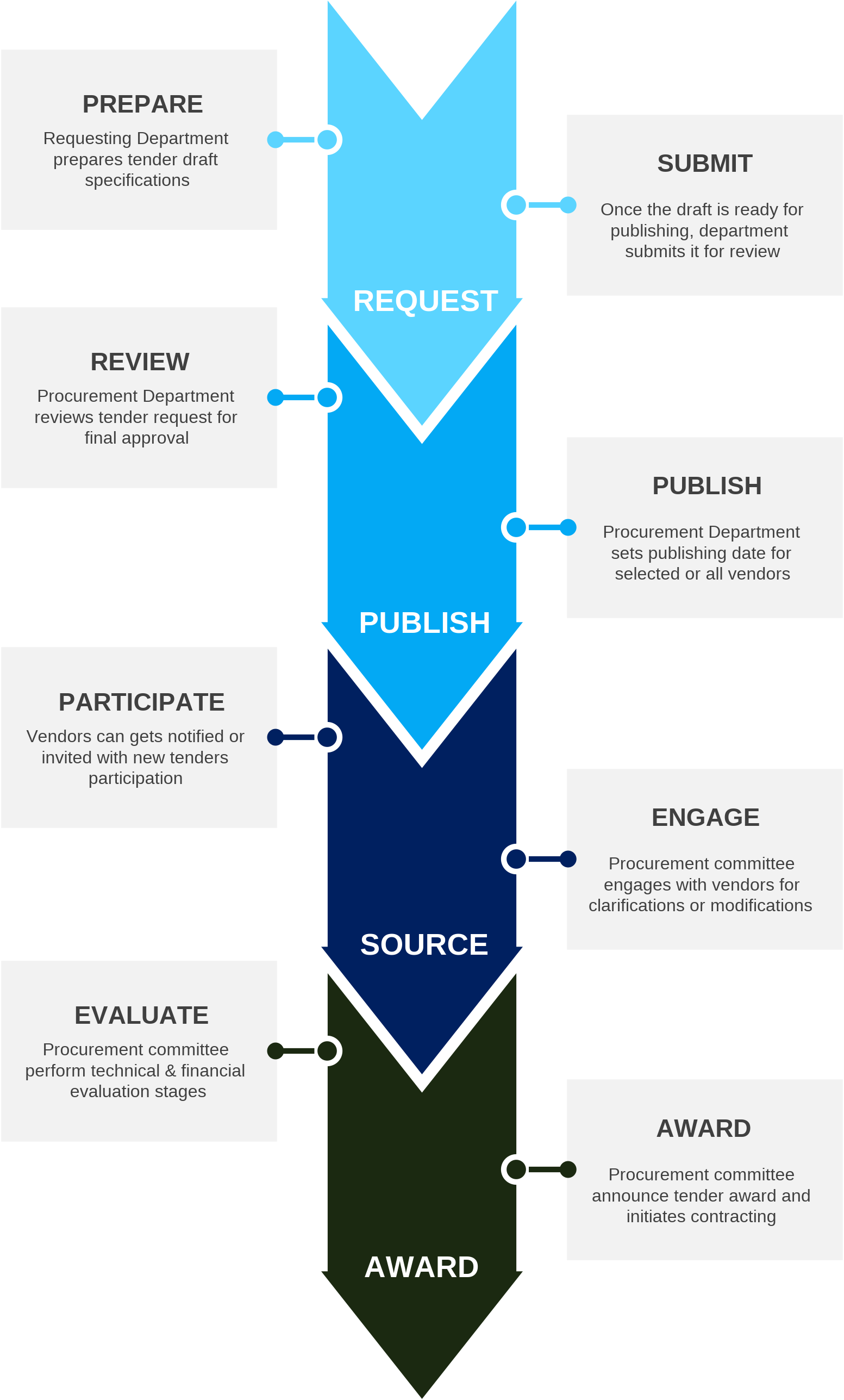
Tendering process overview: request, publish, source and award, with the prepare, submit, review, publish, participate, engage, evaluate and award steps
Inside the workflow

What each team does, from the first draft to the signed contract

01

Tender preparation

The requesting department initiates the tender and completes its specifications and evaluation method through a guided data entry interface.

  • Multi-draft preparation: refine the draft over several iterations before submitting the final version.
  • Multi-stage entry: forms are organized into stages with a guided flow that is easy to follow.
  • Built-in rules engine: keeps entered information accurate and compliant.
  • Built-in document management: attach mandatory documents for the tender type and any additional collateral.
  • Planning dates control: plan dates for the entire process, validated against tender regulations.
  • Link to budget: link each tender to a budget account, with balance validation from the budgeting and planning process.
  • Bill of quantities: a flexible, multi-part BOQ supports scenarios such as alternative offers and partial awards.
  • Committee management: form committees for technical evaluation, financial evaluation or other purposes.
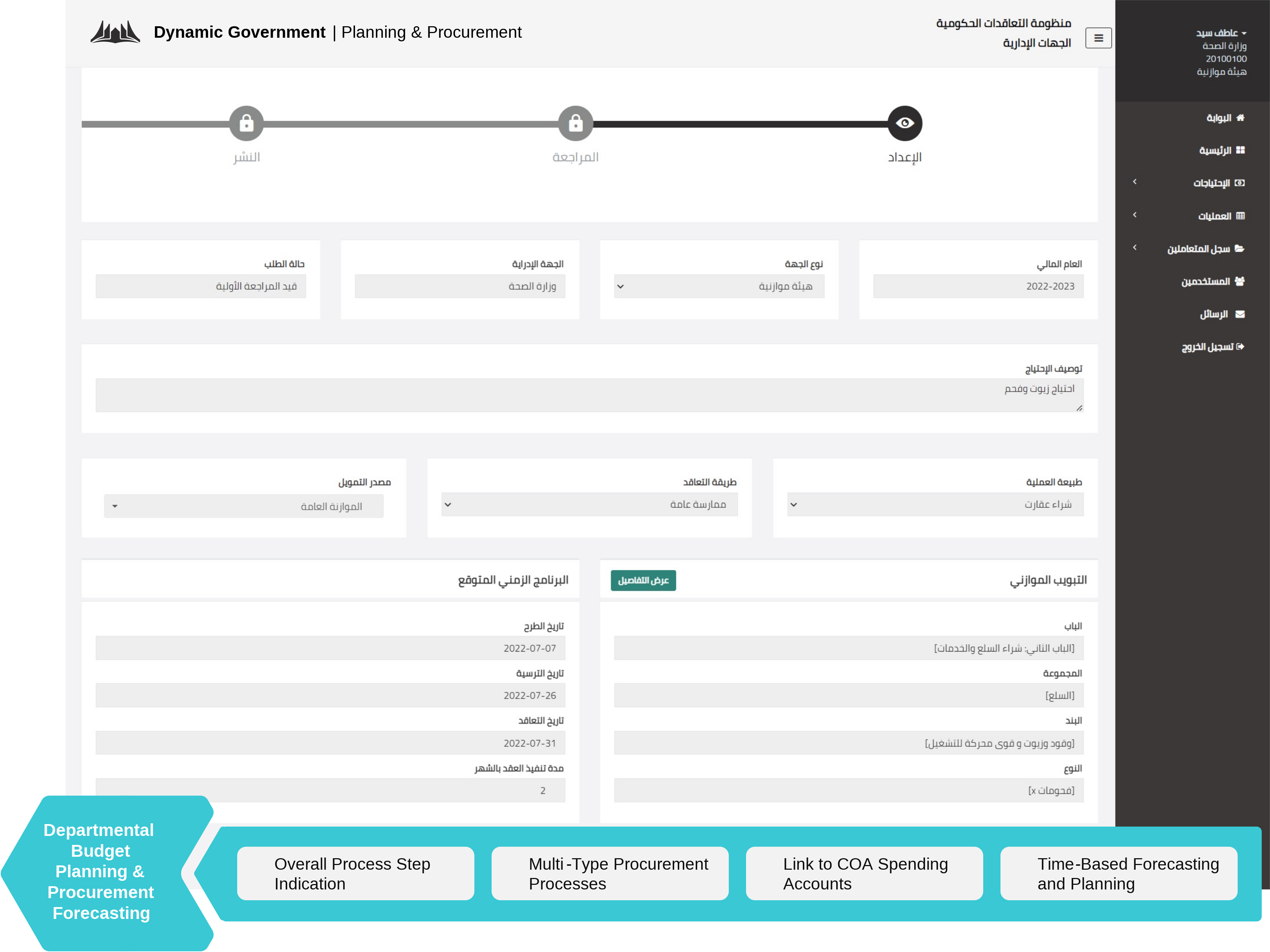
Tender preparation screen with process step indicator, procurement type, spending account link and time-based planning
02

Financial approval, review and publishing

Finance reviews each purchase request and creates the financial commitment against the available budget line. The procurement department then receives all tender requests centrally, checks them for compliance and publishes them to the vendor portal.

  • Checklist review: confirm each tender against a compliance checklist.
  • Member nomination: nominate committee members and grant them access to the tender process.
  • Vendor selection: review the vendor list to confirm eligibility and business continuity, then invite selected vendors or open the tender to all.
  • Tender bonds: set bond types and values, such as tender and performance bonds.
  • Timing deadlines: set the final dates and times for each tender stage.
  • Publish to portal: publish manually, or schedule automatic publication for a set date and time.
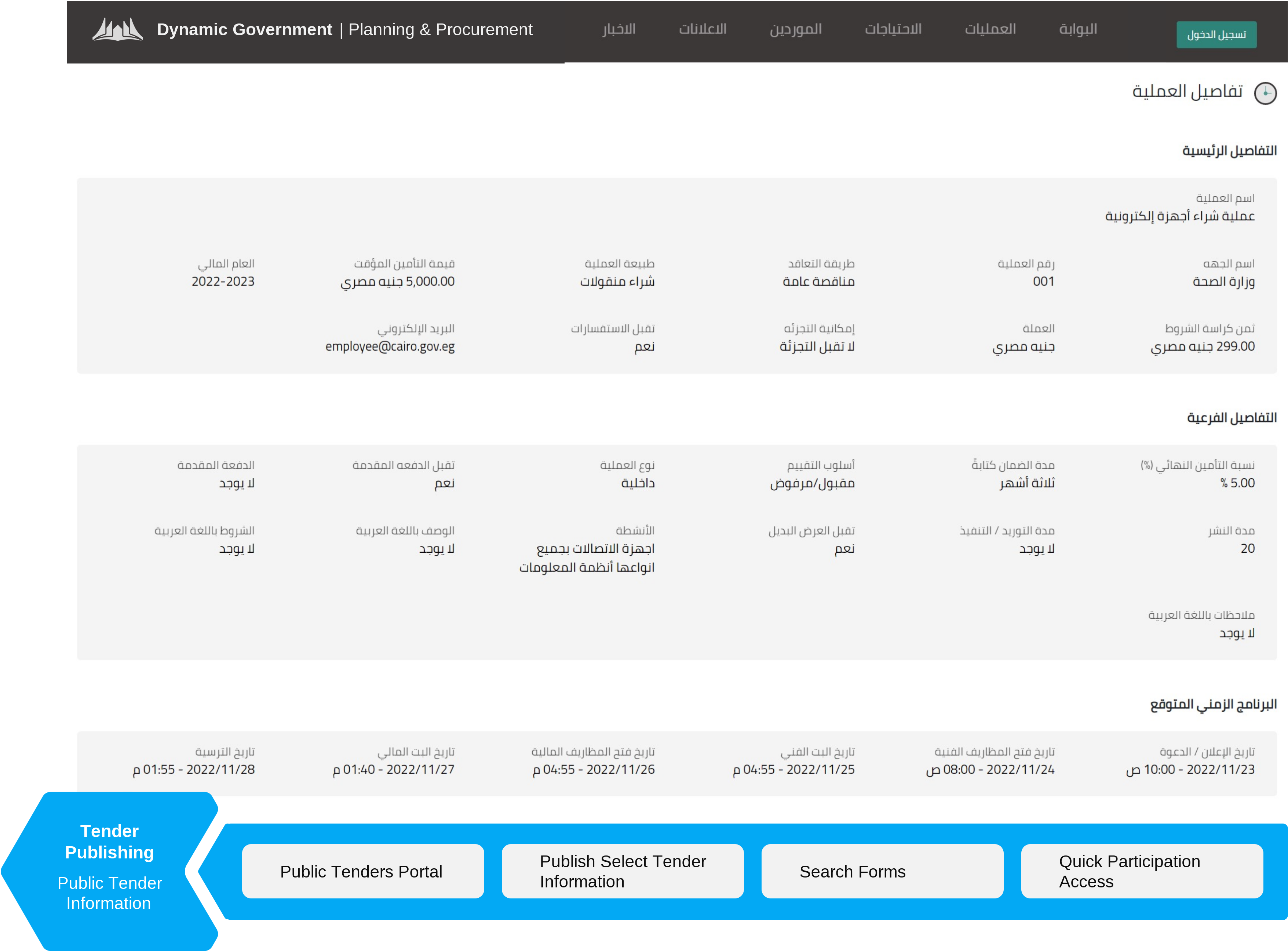
Tender review and publishing screen with public tender information, search forms and quick participation access
03

Vendor participation and sourcing

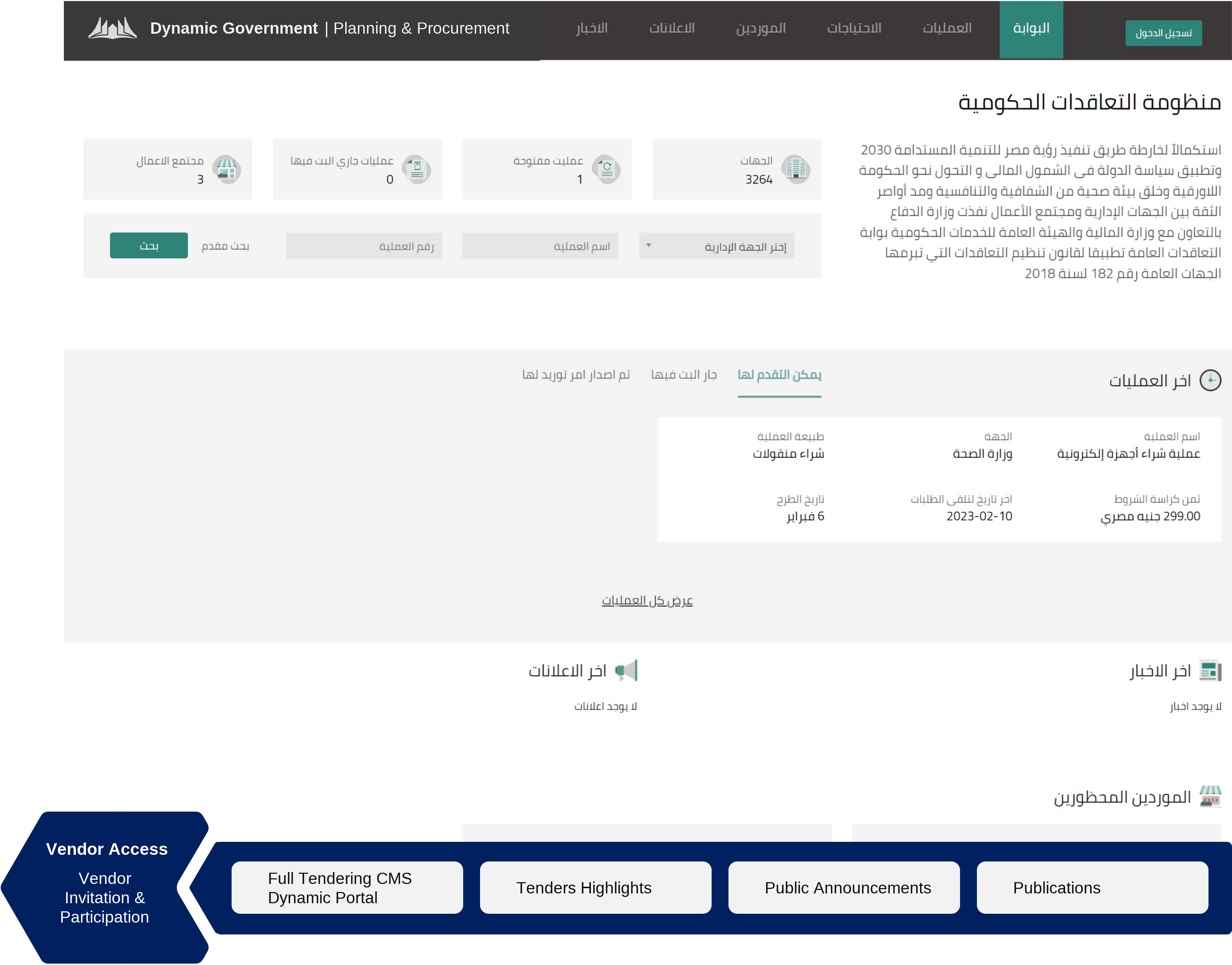
Once a tender is published, vendors are notified if their account was invited, if they match the tender's specialization, or if they subscribe to a related field of business. Registered vendors can then:

  • Public information: read the tender brief before participating.
  • Participation fees: pay participation fees online through a payment gateway.
  • Tender documents: download all tender documents, including the contract template.
  • Announcements: receive tender announcements.
  • Clarifications: send clarification requests and receive answers online.
  • Submit proposals: submit technical and commercial proposals, bills of materials and compliance sheets online, using the method suited to the tender.
  • Tender bond: settle the bond online, or submit evidence that the letter of guarantee was delivered physically.
  • Upload documents: attach general supporting documents or those required by the tender.
  • Complaints: submit complaints at permitted stages of the process.
  • Award access: view shortlisting and award results shared with participants.
Public vendor portal with tender highlights, public announcements and publications
04

Evaluation and awarding

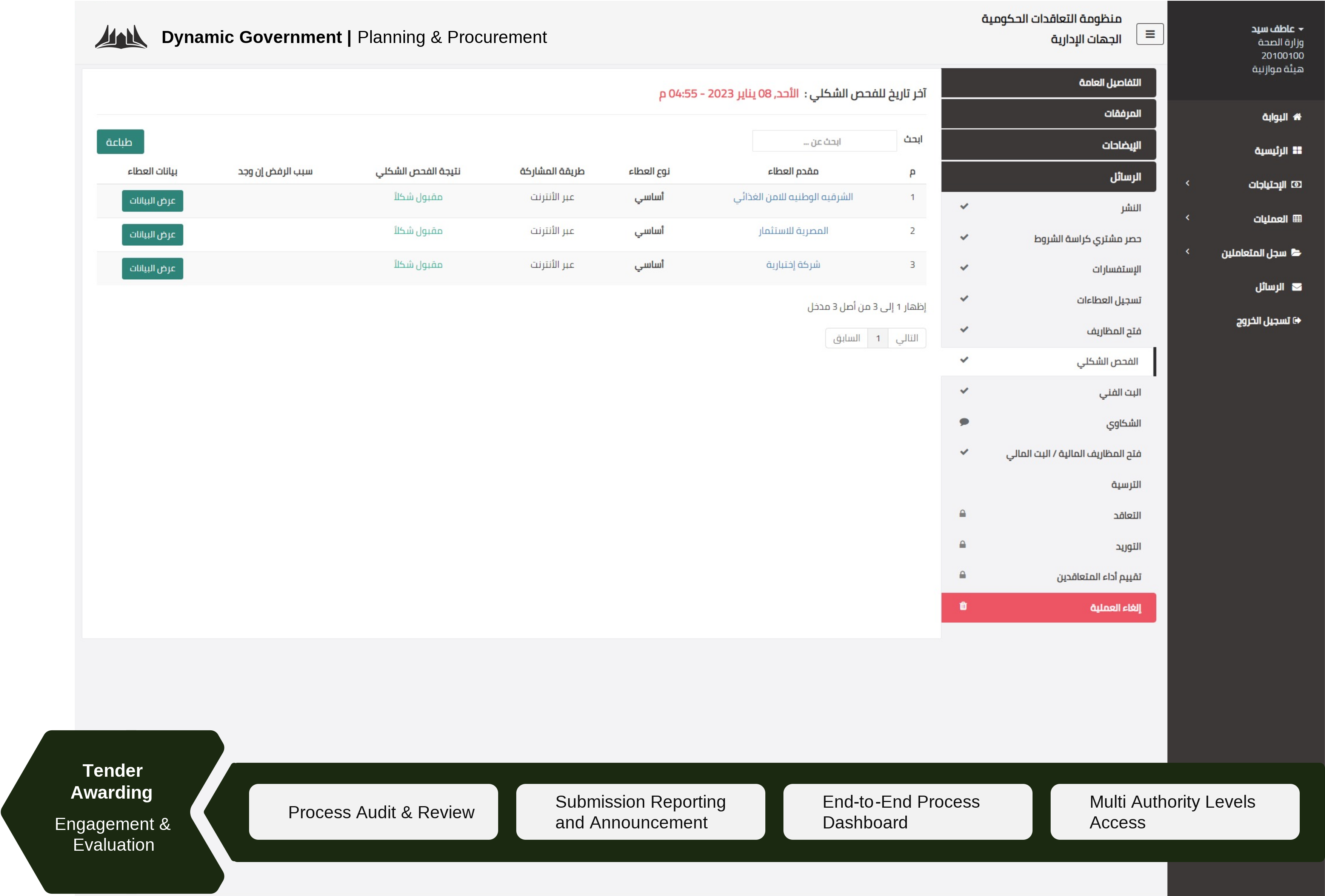
All tender information is held on a secure platform: vendor submissions stay hidden from the procurement committee until submission closes. Technical and financial committees then evaluate the offers, select the candidates for award and award the winning offer.

  • Multi-step evaluation: a staged process, from envelope opening through technical and financial review to award, that enforces regulations.
  • Process audit: each step can be audited individually for compliance.
  • Vendor communication: post-submission clarification exchanges.
  • Call for meetings: schedule vendor proposal presentations and meetings.
  • Sensitive information: access to proposal information can be blocked until the right stage.
  • Evaluation scoring: score-based evaluation across multiple parts of each proposal, with committee formation and responses managed in the system.
  • Partial award: proposals can be partially awarded where the tender allows.
  • Awarding: evaluation and award results can be published automatically to participating vendors.
  • Contract initiation: the contract document is drafted automatically from the award. Manage it from there in Contract Management.
Tender evaluation screen with process audit and review, submission reporting and an end-to-end process dashboard
Workflow features

The workflow in detail, feature by feature

Annotated screens from preparation, vendor participation and evaluation.

Solution components

Eight components give every participant the right way in

Dedicated portals and apps for departments, administrators, committees and vendors, all working on the same tender data.

Tendering & ProcurementDG365
  • Tender Preparation Portal

    Requesting departments initiate a tender with all required details for review and publication to vendors.

  • Public Tendering Website

    Public access to tender announcements and general information, with advanced search, category filters, email notifications and RSS feeds, plus registration for new vendors.

  • Tender Management Portal

    Tender administrators and committees handle every post-publication step, including vendor communication and evaluation.

  • Vendor Portal

    Dedicated access that helps vendors participate and engage in the tendering process.

  • Tendering & Procurement App

    Dedicated access for system management, report extraction and business intelligence.

  • Vendor Mobile app

    Mobile access that notifies vendors about new tenders and the tenders they have joined.

  • Analysis & BI

    Analytical dashboards covering all tender operations and activities.

  • Integration Module

    System interfaces for exchanging information with other software, such as ERP systems.

Functional modules

Five modules protect each tender from creation to award

Together they manage everything from initial requisition through contract award and post-award management.

Tender Creation & Management

Tender authoring with configurable templates, multi-lot support, specification builders, document attachments and automated publication scheduling.

  • Procurement methods: open tender, restricted tender, competitive dialogue, negotiated procedure and framework agreements
  • Automated Q&A: anonymous questions, centralized responses and automatic distribution to all bidders

Bid Submission & Processing

An encrypted submission portal with automated timestamp verification and late-submission prevention. Bids can be amended or withdrawn before the deadline.

  • Sealed bids: PKI-encrypted submission with hardware security module integration keeps bids sealed until the official opening
  • Multi-envelope bidding: separate technical and financial envelopes, so price never influences the technical assessment

Evaluation & Scoring Engine

Weighted multi-criteria evaluation with automated score calculation and committee management, for both qualitative and quantitative criteria.

  • Weighted scoring, pass/fail criteria, mandatory requirements and custom methodologies
  • Individual and consensus evaluation modes
  • Automated ranking with tie-breaking rules

Award & Contract Management

Automated award recommendations, committee approval routing and award notifications.

  • Standstill period management
  • Contract generation from templates, with digital signature integration

Anti-Fraud & Integrity Module

A risk score for every procurement, with automated alerts for suspicious patterns.

  • AI-powered bid pattern analysis flags suspicious pricing, coordinated submissions and other collusion indicators
  • Conflict-of-interest declarations and whistleblower channels
  • Immutable, timestamped logging of every action from tender creation to award, with full non-repudiation
Time- and event-based access

Sensitive information opens only at the right stage

The platform applies event- and role-based access to sensitive information throughout the tendering process. Access roles are configurable to match the regulations you adopt, and these rules are ready out of the box.

AccessRoleEventCondition
TenderCommittee memberCommittee assignmentTender approved and committee work has started
BidBid memberBidding is closedValid only once the bid stage is closed
Technical proposalBid memberBidding is closedValid only once the technical evaluation stage begins
Financial proposalBid memberBidding is closedValid only once the financial evaluation stage begins
Built-in services

Notifications, templates, AI assistants and verified sign-in come standard

Multi-channel notifications

A notification service, enabled by default, sends automated messages by email, SMS and system interface at key events:

  • New tender drafting and tender publishing
  • Approaching tender deadlines
  • Clarification responses
  • Award announcements and general announcements

Ready-made procurement templates

The system generates the standard forms that document and govern each step of the procurement cycle, including:

  • Item request and tender request forms
  • Special conditions form
  • Contract form and Ministry of Finance forms
  • Award meeting minutes

AI assistants for staff and vendors

The platform architecture supports integrated chatbots that serve users inside and outside the organization.

  • For employees: answers questions, guides users through procurement procedures and speeds up access to information.
  • For vendors: available 24/7 in the Vendor Portal to answer common questions, show bid status and help with navigation.

Unified, verified sign-in

Unified authentication protects user data and supports compliance with digital governance requirements.

  • Internal users: single sign-on with the organization's own credentials through Microsoft Azure Active Directory.
  • External users: vendor and citizen identities are verified through Kuwait's Hawiyati service, in line with national standards.
Mobility

Tendering on the go, for administrators and vendors

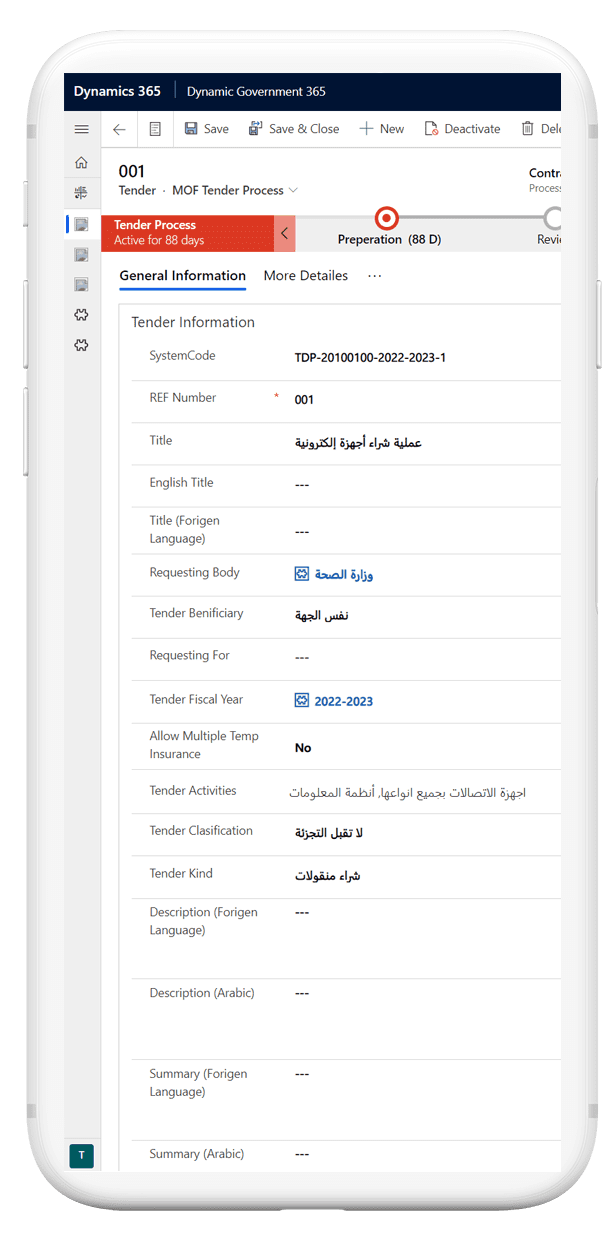
Tendering Administration mobile app

The tendering organization gets full mobile access to the process.

  • End-to-end mobile access to the entire process from an administrative perspective
  • Quick actions for the most common tasks, such as process review and step authorization
  • Access to system notifications
  • Quick management of users and user activity
  • Management of departmental requests and operations
Tendering Administration mobile app showing a tender record on a smartphone

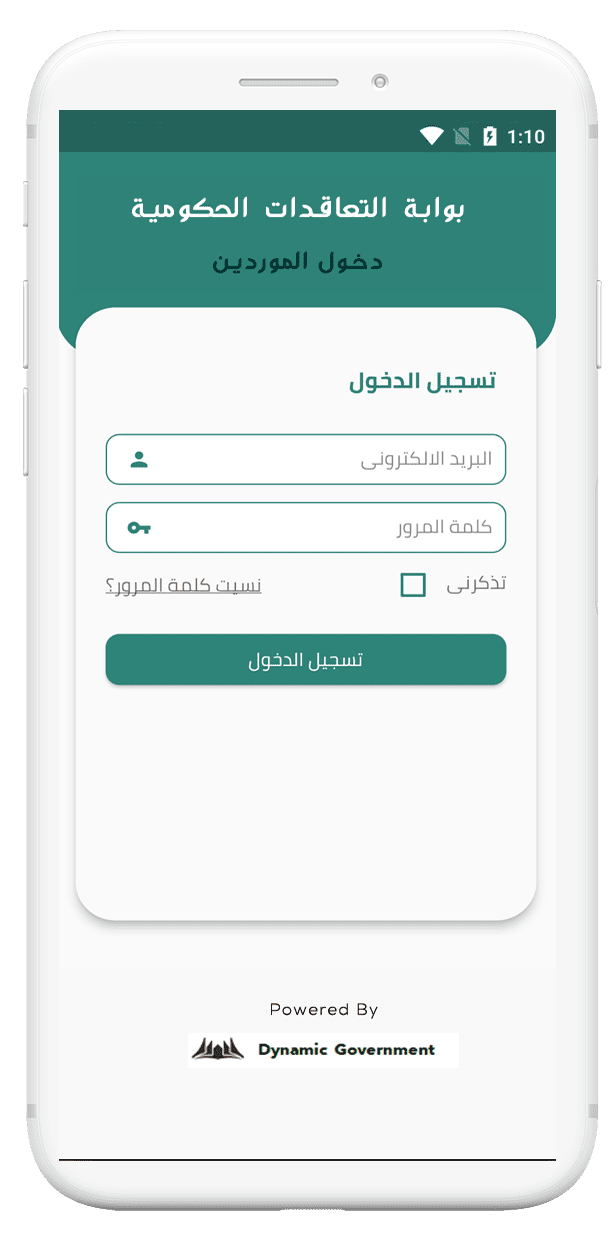
Tendering mobile app for vendors

Participating vendors stay connected to every tender from their phone.

  • Access new tenders
  • Access notifications and announcements
  • Access tender participations
  • View the latest awards
  • Receive reminders for vendor engagement activities
Tendering mobile app for vendors showing the vendor sign-in screen (Arabic interface)
Business intelligence

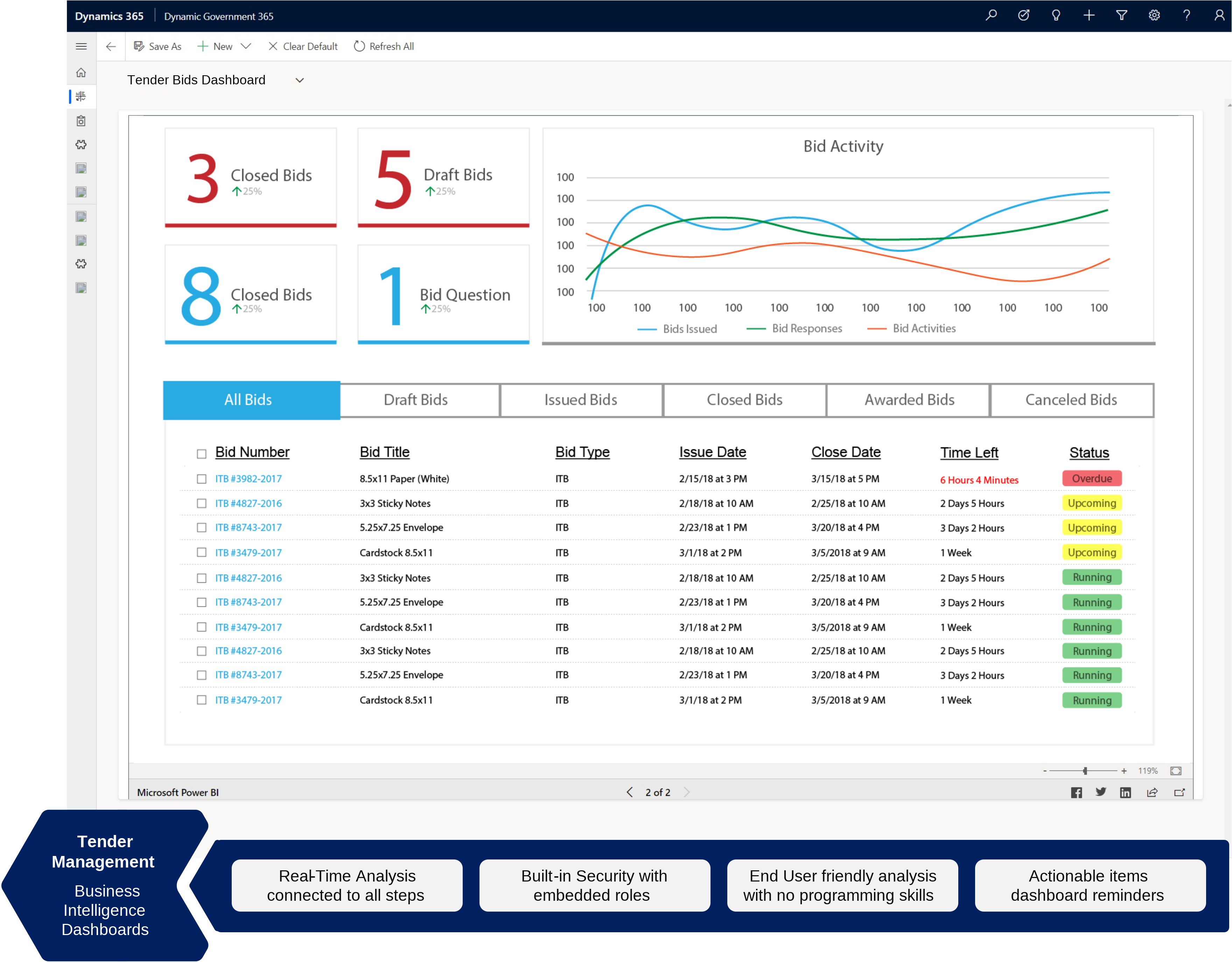
Power BI shows where every tender stands

Power BI connects to your tendering data, builds visuals and delivers business intelligence quickly, so you can analyze complex procurement data and drive continual improvement.

  • Real-time analysis connected to every step of the process
  • Charts, dashboards and maps presented in an easy-to-digest format
  • Natural-language queries with instant results, with no programming skills needed
  • Built-in security with embedded roles
  • Actionable dashboard items and reminders
Power BI tender bids dashboard with bid counts by status, bid activity chart and bid list
The procurement year

Tendering is phase three of a four-phase procurement cycle

Government procurement and contracting runs in phases that bring the requesting department, finance and procurement into one collaborative workflow. Each phase reflects part of the laws and regulations that govern public purchasing, which strengthens governance and transparency across the cycle. Phases one and two run in the Internal Budgeting System.

Procurement cycleEvery fiscal year
  1. 01

    Planning

    Departments collect their purchasing needs and plan spending for the coming fiscal year.

  2. 02

    Review and approval

    Financial appropriations are approved and the forms and documents required for tendering are completed.

  3. 03

    Purchasing and contracting

    Tenders are issued, offers received and evaluated, awards made and contracts signed with suppliers.

  4. 04

    Follow-up

    Spending against the financial appropriations is tracked and contract execution is managed.

Running through every phase: electronic publication of the needs plan, vendor registration and classification through a dedicated portal, and management of committee work.

Architecture

A secure, layered architecture on the Microsoft cloud

One unified portal serves every stakeholder, backed by a procurement processing engine, a compliance and security framework, and Microsoft business applications running on Azure.

Azure infrastructure Business applications Compliance & security Processing engine eTendering portal Stakeholders
  1. 01

    Stakeholders

    External: vendors, bidders, consultants and the public. Internal: procurement officers, evaluation committees and finance.

  2. 02

    Unified eTendering portal

    One entry point for tender publication, bid submission, Q&A management, status tracking and award notifications.

  3. 03

    Procurement processing engine

    Tender creation, publication and amendment. Bid submission, encryption and envelope management. Multi-criteria scoring and committee management. Award notification, approval and contract generation.

    • Tenders
    • Bids
    • Evaluation
    • Awards
  4. 04

    Compliance and security

    A compliance and audit framework with regulatory rules, audit trails and anti-collusion controls, on a security layer with PKI encryption, digital signatures and zero trust.

    • Audit trails
    • PKI encryption
    • Zero trust
  5. 05

    Microsoft business applications

    Microsoft Dynamics and SharePoint, with the Power Platform components for apps, automation and analytics.

    • Power Apps
    • Power Automate
    • Power BI
  6. 06

    Azure infrastructure

    Enterprise cloud infrastructure on Microsoft Azure, with Blob Storage, API Management, Azure Functions and Integration Hub, Notification Hubs, Synapse Analytics, Azure OpenAI and App Service.

    • Dataverse
    • Data Lake Gen2
    • Key Vault
Tiered editions

Choose the entry point that matches your procurement maturity

Each tier includes everything in the one before, so you can start with core digital tendering and add governance and AI as your ambitions grow.

Tier 1 · Foundation

For agencies establishing basic digital tendering.

  • Procurement drafting and authorization
  • Publishing and tender management
  • Integration with spending management
  • Contract template management
  • Manual document vault

Tier 2 · Advanced GovernanceRecommended

Everything in Foundation, plus vendor self-service and Document AI.

  • Vendor self-service portal
  • Digital eSubmission (proposal upload)
  • Hawiyati (Kuwait National ID) integration
  • Full Document AI with RAG, NLP and auto-fill

Tier 3 · Enterprise Cognitive

Everything in Advanced Governance, plus full enterprise capabilities.

  • Advanced AI analytics and insights
  • Committee meeting management
  • Full-process contract lifecycle management
  • ERP bidirectional synchronization
  • AI anomaly detection and spend analysis
  • Macroeconomic taxonomy enforcement
System screenshots

The eTendering system, screen by screen

Screens from the public portal, tender preparation, vendor communication, and evaluation through to contract.

Technologies

Built on the Microsoft cloud

Tendering & Procurement is one of the Core Solutions of the Dynamic Government 365 platform. First released in 2016 for governments in Kuwait and the GCC, the platform has since been rebuilt on Microsoft 365 and Azure around four core values: compliance, automation, transparency and integration.

Microsoft Dynamics 365

Microsoft Dynamics 365

The procurement processing engine and ERP integration.

Microsoft Power BI

Microsoft Power BI

Tendering analytics and dashboards.

Microsoft Azure

Microsoft Azure

Secure infrastructure: Dataverse, Blob Storage, Data Lake, API Management and Key Vault.

Android

Android

Administration and vendor mobile apps.

iOS

iOS

Administration and vendor mobile apps.

Make every tender transparent and defensible

See the full tender lifecycle running on your own procurement rules, from the first draft to the signed contract, with the Internal Budgeting System upstream and Contract Management downstream.